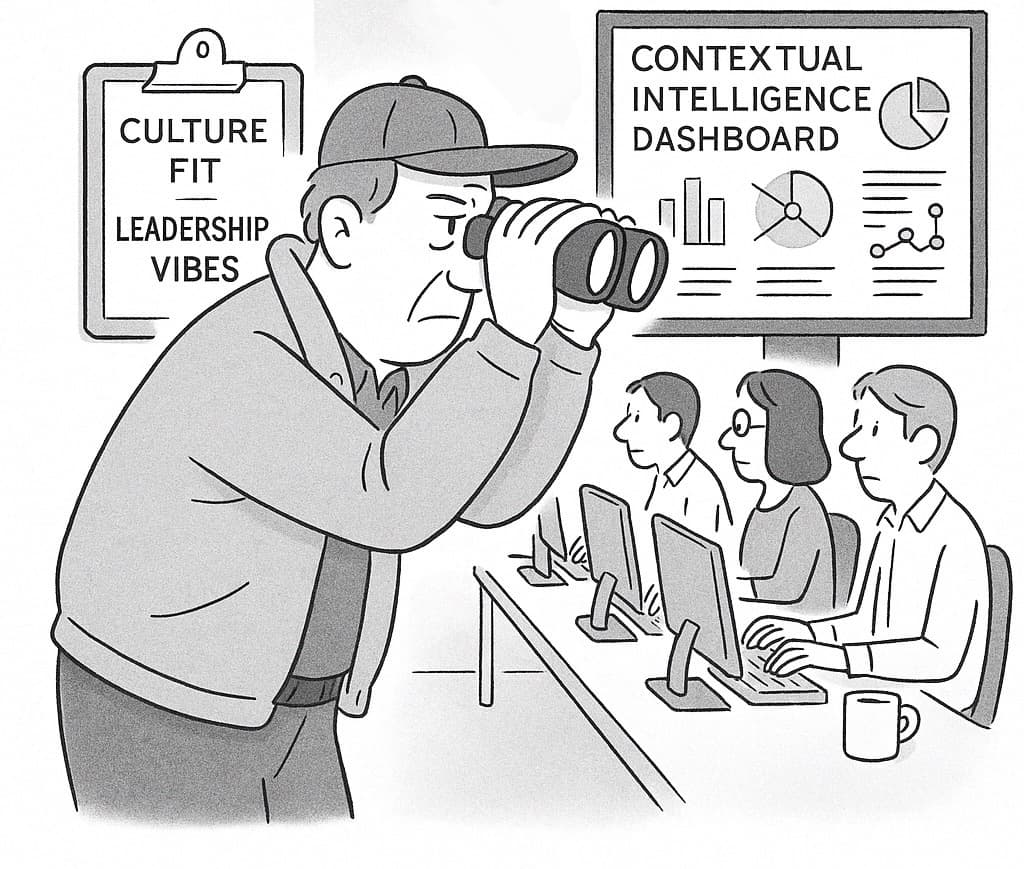
From Gut Feelings to Contextual Intelligence
There was a time when baseball teams chose players the way most companies still build teams today: by gut.
Scouts would watch a player swing a bat or throw a pitch and evaluate them based on a set of unspoken heuristics: “He’s got a strong arm,” “He moves like a natural,” “He looks like a winner.” These judgments were built on experience, but they were subjective, full of bias, and often missed real potential. Players were selected or passed over based on how they appeared—not how they performed.
Then came a quiet revolution.
A group of analysts, most famously portrayed in the story of Moneyball, began to question the assumptions. They asked: What if we’re measuring the wrong things? What if the most important indicators of performance are hidden in data we’ve been ignoring?
They didn’t just invent new statistics—they reorganized how talent was understood. They created models that revealed the real attributes that led to success on the field. And they used those models not just for hiring, but for team composition, game strategy, and long-term investment in player development.
It worked. And it changed everything.
Today, baseball scouts still watch with their eyes—but their eyes are guided by something deeper: structured context.
We’re Still Scouting People Like It’s the 1970s
Now zoom out.
Think about how most organizations evaluate people. Not athletes—employees, collaborators, creatives, teammates.
Despite decades of research in psychology, management science, and cognitive behavior, most decisions about people are still made the same way baseball once was: through subjective impressions, gut feeling, and vague categories like “culture fit” or “leadership potential.”
Even when tools like personality tests, psychometric assessments, or values inventories are used, they’re usually siloed—one-off snapshots. A report gets filed. Maybe someone glances at a PDF. Then it’s forgotten.
We’re sitting on an enormous amount of self-knowledge and behavioral insight, but we haven’t built a system that makes it usable.

What If You Had a Structured Context Map?
Imagine a system—a simple diagnostic interface—that could take your existing personal data:
- Your Myers-Briggs or Big Five results
- Your relational patterns
- Your working style preferences
- Your psychometric profiles
- Even your natal chart, if you find symbolic value in it
And instead of treating these as isolated traits, it structures them into a Contextual Intelligence Map—a personal model that helps teams, systems, or even AI assistants understand you with nuance.
This map wouldn’t just say “You’re an INFP” or “You’re highly conscientious.”
It would model:
- The environments where you thrive
- The kinds of work that energize or drain you
- Your natural conflict resolution tendencies
- How you learn best, receive feedback, and make decisions
And it would do so in a structured, interoperable way—so the information could be used in real workflows.
From Qualitative to Quantitative (Without Losing the Human)
We’re not talking about reducing people to numbers.
We’re talking about creating structured representations of otherwise qualitative realities—the same way sabermetrics turned baseball from a gut game into a science of context.
In the same way that a player’s “on-base percentage” gave teams a clearer view of value than a flashy swing, a Contextual Intelligence Model could surface:
- Who’s likely to thrive under a particular manager
- Which team dynamics need buffering or balancing
- How to distribute roles not by title, but by actual behavioral patterns
- How to personalize documentation, onboarding, or communication for each team member
- How to evolve systems around people—not force people into systems
The Technology Is Ready. The Philosophy Needs Catching Up.
With modern AI systems, especially large language models, we can now use this kind of structured personal context not just as data—but as living memory.
An AI assistant could help you:
- Write messages in a tone aligned with your recipient’s communication profile
- Avoid calendar overload based on your known fatigue rhythms
- Suggest collaborations based on complementary thinking patterns
This isn’t science fiction. The only missing piece is the structured diagnostic layer that organizes your context clearly enough to use it as an interface.

Why This Matters
Understanding people deeply has always mattered. But until now, we’ve lacked the tools to do it reliably, respectfully, and at scale.
A Contextual Intelligence System isn’t just a new HR tool. It’s a new paradigm.
- One where teams aren’t just efficient—they’re attuned.
- Where onboarding isn’t generic—it’s personalized.
- Where systems reflect people—instead of forcing people to reflect systems.
We’ve already seen what happened in baseball when teams got serious about structuring context.
Imagine what might happen when we do that for ourselves.